Monday, April 6, 2026
Interview Scorecard: How to Build One (With a Sample Template)

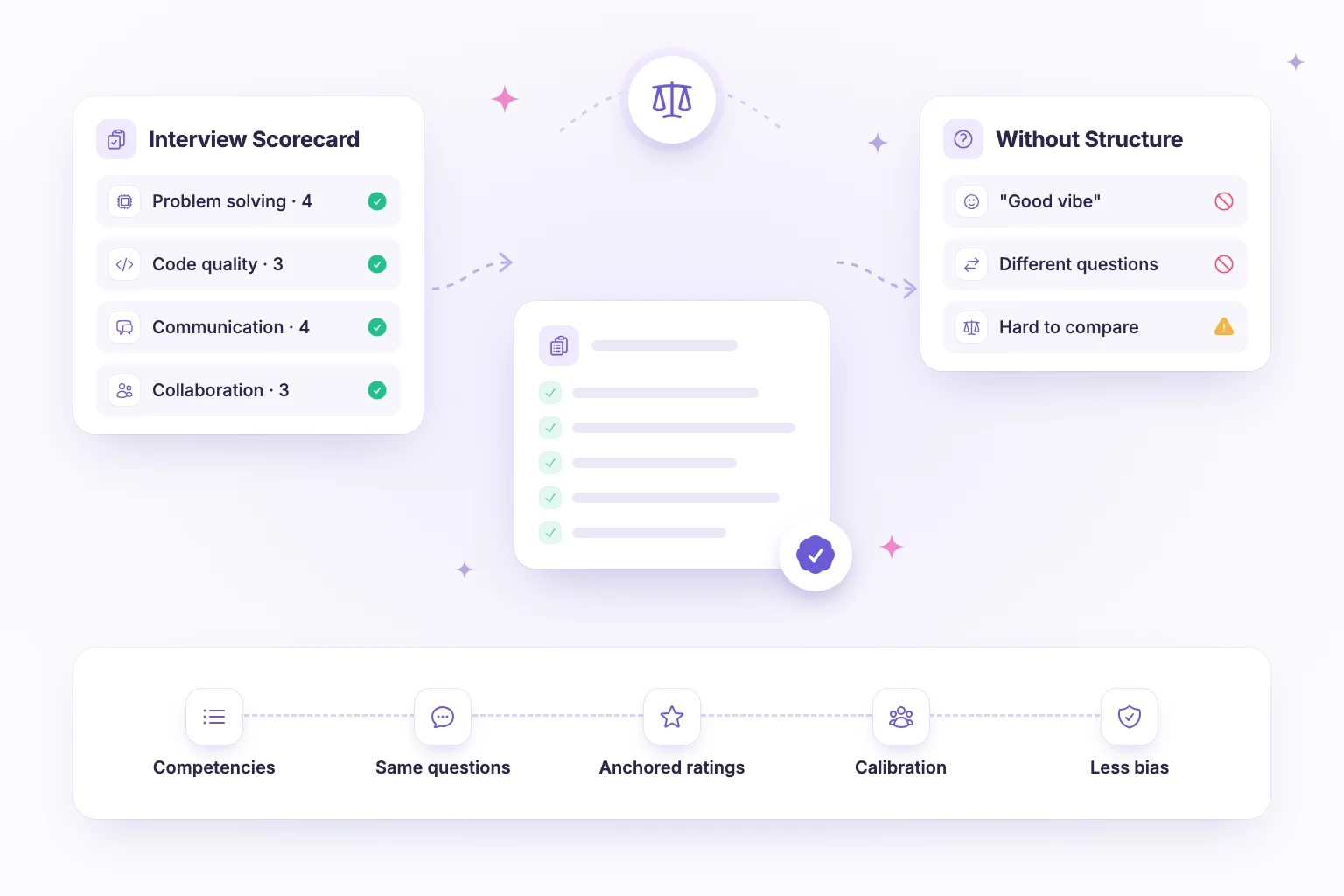
An interview scorecard is a structured form that lists the competencies a role needs, a rating scale for each and clear descriptions of what each rating looks like. Every interviewer rates every candidate against the same criteria and records the evidence. Used with structured interviews, scorecards make hiring decisions more consistent, faster to reach and easier to defend.
This guide explains how structured interviews work, how to build a scorecard step by step, a sample scorecard for a backend engineer, and how to calibrate interviewers so the scores mean something.
What is a structured interview?
A structured interview has three features:
- Pre-defined competencies. The team decides what to assess before meeting any candidate.
- Consistent questions. Every candidate for the role answers the same core questions, with room for follow-ups.
- A shared rating scale. Answers are scored against written anchors, not gut feel.
Unstructured interviews tend to drift towards rapport. The interviewer likes the candidate, the conversation flows, and the rating reflects that feeling more than the candidate's ability. Structure does not make interviews robotic. It makes sure the time is spent collecting evidence on the things that matter.
How to build an interview scorecard
Step 1: Choose four to six competencies
Start from the role's skills profile. Pick the competencies that most strongly predict success and that you can observe in an interview. For an engineering role these might be technical depth, problem solving, system design, communication, collaboration and ownership. If you are starting from scratch, our skills-based hiring guide explains how to derive competencies from role outcomes.
Step 2: Define each competency in one sentence
"Communication" is too vague. "Explains technical decisions clearly, adjusts detail for the audience and checks for understanding" gives interviewers something to look for.
Step 3: Write behavioural anchors for a 1 to 4 scale
Anchors are short descriptions of what a candidate at each level says or does. They are the most important part of the scorecard. Use a four-point scale:
- 1 — Strong no: clear evidence the candidate does not meet the bar.
- 2 — Leaning no: some relevant evidence, but significant gaps.
- 3 — Leaning yes: meets the bar for the level with minor gaps.
- 4 — Strong yes: clearly exceeds the bar with specific, convincing evidence.
An even-numbered scale has no neutral middle, which forces a decision on each competency.
Step 4: Map questions to competencies
Write two or three primary questions per competency, plus likely follow-ups. Behavioural questions ("Tell me about a time you…") and situational questions ("What would you do if…") both work, as long as the anchors describe what good answers contain.
Step 5: Assign competencies to interviews
Each interviewer owns two or three competencies. This avoids five people all asking about teamwork while nobody probes system design.
Step 6: Add an evidence field and an overall recommendation
For each competency, require a short note of what the candidate said or did. End the scorecard with an overall hire or no-hire recommendation and a one-line summary.
Sample interview scorecard: backend engineer
Below is a sample interview rubric for a mid-level backend engineer. Adapt the competencies and anchors to your team and level.
| Competency | 1 — Strong no | 2 — Leaning no | 3 — Leaning yes | 4 — Strong yes |
|---|---|---|---|---|
| API design | Cannot describe a reasonable endpoint structure; ignores errors | Workable design but inconsistent naming or no error handling | Clear, consistent endpoints with sensible status codes and validation | Also considers versioning, pagination and backward compatibility unprompted |
| Data modelling | Schema has obvious redundancy or missing relationships | Basic schema works but trade-offs are not explained | Normalised schema; explains indexes for the main queries | Discusses when to denormalise, migration strategy and data integrity |
| Problem solving | Jumps to code without understanding the problem; stalls when stuck | Reaches a solution only with heavy hints | Clarifies requirements, breaks the problem down, tests edge cases | Compares approaches, explains complexity and chooses deliberately |
| Debugging and reliability | Guesses at causes; no systematic approach | Finds the issue slowly; limited thought about prevention | Isolates the fault methodically; suggests tests or monitoring | Describes real incidents, root cause analysis and lasting fixes |
| Communication | Answers are unclear or hard to follow | Understandable but disorganised; misses the question at times | Clear, structured explanations; checks understanding | Adjusts detail for the audience; makes complex ideas simple |
| Collaboration and ownership | Blames others; no examples of taking responsibility | Examples are vague or only describe the team's work | Specific examples of owning work and handling disagreement constructively | Examples of improving team practices or mentoring others |
Sample questions to pair with this scorecard:
- API design: "Design the endpoints for a service that lets users schedule and cancel appointments."
- Debugging: "Tell me about the hardest production bug you have fixed. How did you find it?"
- Collaboration: "Describe a time you disagreed with a technical decision. What happened next?"
For more role-specific prompts, see our list of backend developer interview questions.
Interview calibration: making scores mean the same thing
A scorecard only works if a "3" from one interviewer means the same as a "3" from another. Calibration closes that gap.
- Run a kickoff. Before interviews start, walk the panel through the competencies, questions and anchors.
- Score sample answers together. Take two or three anonymised answers and have everyone rate them independently, then compare. Discuss any difference of two points or more.
- Shadow and reverse-shadow. New interviewers observe, then lead with an experienced interviewer observing.
- Review score patterns. After each hiring cycle, check whether some interviewers are consistently harsher or more lenient than others.
- Refine anchors. If people keep disagreeing on a competency, the anchor is probably unclear. Rewrite it.
How scorecards reduce interview bias
No process removes bias completely, but structured scorecards reduce several of its common sources:
- Similarity bias: anchors focus attention on evidence rather than shared background or interests.
- Halo effect: rating competencies separately stops one strong impression from lifting every score.
- Anchoring: independent submission before the debrief stops early opinions from shaping later ones.
- Recency and memory errors: writing evidence immediately after the interview beats recalling it days later.
- Inconsistent bars: the same questions and anchors for every candidate make comparisons fairer.
Two habits help further: submit scorecards within 24 hours, and start debriefs by reading the evidence rather than going round the room for opinions.
Common interview scorecard mistakes
- Anchors that repeat the scale. "Good communication" for a 3 and "excellent communication" for a 4 gives interviewers nothing to compare against. Describe observable behaviour instead.
- Rating "culture fit". It is too vague to score consistently and invites similarity bias. Replace it with specific, job-relevant competencies such as collaboration or ownership.
- Scoring without evidence. A rating with no note cannot be discussed or challenged. Make the evidence field mandatory.
- Averaging away concerns. A 4, 4, 4 and 1 averages to a comfortable 3.25, but the 1 may be a blocker on a must-have skill. Discuss low scores explicitly.
- Never updating the template. Roles change. Review the competencies and anchors at least once a year, or whenever the team's needs shift.
- Filling it in days later. Memory fades quickly. Block 15 minutes straight after each interview to complete the scorecard.
How NirnAI helps with interview scorecards
NirnAI includes structured scorecard templates, so every candidate for a role is rated against the same rubric by every reviewer. You define the competencies and scale once and reuse the template across jobs.
Scorecards work best when they are fed by good evidence. Alongside live interviews, you can add open-ended written questions and recorded video responses to an assessment, so reviewers can rate communication and reasoning asynchronously against the same rubric. See all the assessment question types NirnAI supports, including auto-scored multiple choice and in-browser coding with test cases.
Role-based access lets you add hiring managers and per-job reviewers or observers, and analytics show score distributions and section-level breakdowns so you can see how candidates perform across each part of the process. Interview scheduling with Google Calendar and Microsoft Outlook lets candidates self-book slots, and visual hiring workflows move candidates to the next stage automatically.
Ready to make every interview count? Start a 14-day free trial and set up your first scorecard template.
Frequently asked questions
- What is an interview scorecard?
- An interview scorecard is a form each interviewer completes after speaking with a candidate. It lists the competencies the role requires, a rating scale for each, and descriptions of what each rating looks like. Interviewers record a rating and the evidence behind it. Because every candidate is rated on the same criteria, scorecards make decisions more consistent, easier to compare and easier to explain.
- Why use a 1 to 4 rating scale instead of 1 to 5?
- A four-point scale has no neutral middle, so interviewers must decide whether a candidate is below or above the bar on each competency. On five-point scales many ratings cluster at 3, which gives the hiring team little to work with. Four points, each with a clear behavioural anchor, is usually enough resolution while staying quick to use.
- How many competencies should an interview scorecard have?
- Aim for four to six competencies for the whole process, and two or three per individual interview. More than that and interviewers struggle to gather evidence for each one in the time available, so ratings become guesses. Assign competencies to specific interviews so every skill is covered once or twice across the loop without unnecessary duplication.
- Should interviewers see each other's scorecards before the debrief?
- No. Ask every interviewer to submit their scorecard independently before the debrief or before seeing anyone else's ratings. Seeing a colleague's score first tends to anchor your own judgement, especially if that colleague is more senior. Independent submission preserves the value of having several people assess the same candidate from different angles.