Tuesday, August 25, 2026
The True Cost of a Bad Hire (and a Framework to Prevent It)

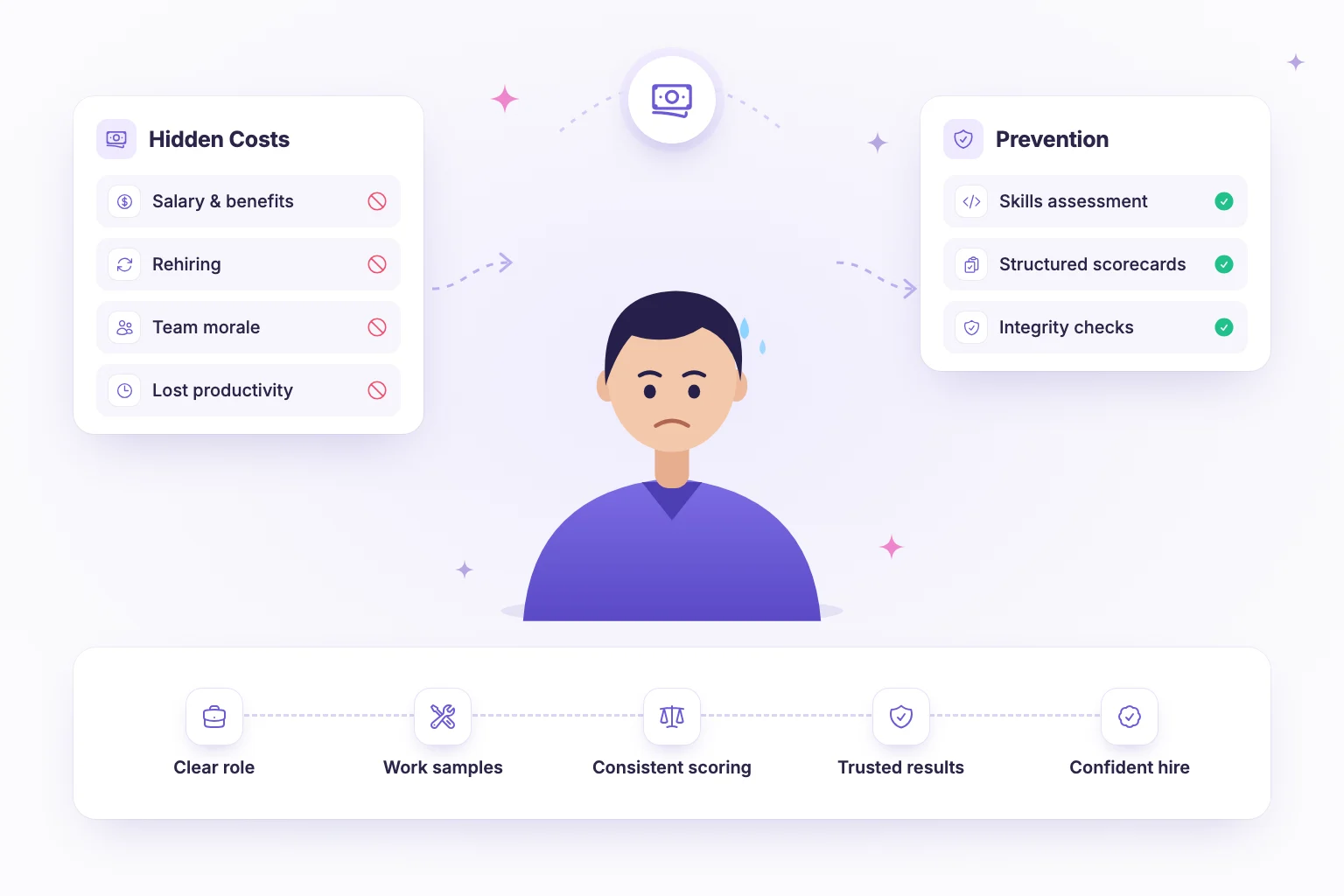
The cost of a bad hire is much larger than the salary you paid. The U.S. Department of Labor estimates a bad hire can cost at least 30% of the employee’s first-year earnings, and that is before you count lost team productivity, missed deadlines, management time and the cost of hiring again. The good news is that most bad hires trace back to a handful of fixable process problems.
This article breaks down the direct and hidden costs, walks through an illustrative example, explains why bad hires happen, and gives you a practical framework to prevent them.
What counts as a bad hire?
A bad hire is not simply someone who did not work out. It is a hire where the gap between what the role needed and what the person could deliver was visible, or could have been made visible, before the offer. Common patterns include:
- The person lacks a core skill the role depends on, such as writing production code or analysing data independently.
- The person can do the work but not at the seniority level the role requires.
- The person’s working style clashes with how the team operates, and the clash was never explored during interviews.
- The person misrepresented their skills, and the process had no way to verify them.
Notice that most of these are failures of measurement. The process did not test the right things, or tested them inconsistently.
The direct costs of a bad hire
Direct costs are the ones finance can see on a spreadsheet:
- Salary and benefits paid during the months the person was in the role.
- Recruiting costs for the original hire: job ads, agency fees, sourcing tools and recruiter time.
- Onboarding and training, including equipment, licences and the time of whoever trained them.
- Separation costs, such as notice periods, severance or legal advice where relevant.
- Rehiring costs, because you now have to run the whole process again.
The hidden costs of a bad hire
The hidden costs are harder to measure and usually larger:
- Lost output. The seat was technically filled, but the work was not getting done, or was getting done badly.
- Rework. Colleagues spend time fixing code, reports or customer issues the person got wrong.
- Management time. Managers spend hours on coaching, performance plans and difficult conversations instead of leading the team.
- Team morale. Strong performers notice when a weak hire is carried, and some start looking elsewhere.
- Customer and reputation impact. Mistakes in customer-facing roles can cost accounts and damage trust.
- Opportunity cost. The months spent on a bad hire are months you could have had a good one.
A worked example: estimating the cost of a bad hire
The table below is purely illustrative. It uses a hypothetical mid-level role with a first-year salary of 80,000 (in any currency) and assumes the person leaves after six months. The numbers are round assumptions to show how the categories add up, not benchmarks or survey data. Replace them with your own figures.
| Cost category | Illustrative assumption | Illustrative amount |
|---|---|---|
| Salary and benefits paid | Six months of salary plus benefits | 46,000 |
| Original recruiting cost | Ads, sourcing and recruiter time | 8,000 |
| Onboarding and training | Equipment, licences, trainer time | 5,000 |
| Lost and reworked output | Share of salary value not delivered, plus colleague fixes | 20,000 |
| Management time | Coaching, performance plan, exit process | 6,000 |
| Rehiring cost | Running the full process again | 8,000 |
| Total (illustrative) | 93,000 |
Not all of that is pure loss, since the person delivered some value. But even if you only count the recruiting, onboarding, rework, management and rehiring lines, the total comfortably clears the Department of Labor’s 30% floor of 24,000 for this salary. The exercise is worth doing with your own numbers, because it turns “we should hire more carefully” into a concrete business case.
Root causes: why bad hires happen
When teams run a post-mortem on a bad hire, the same causes appear again and again.
1. The role was never properly defined
If the job description lists fifteen “required” skills, nobody knows which three actually matter. Interviewers end up testing whatever they personally care about. See our guide on how to write a job description for developers for a better starting point.
2. Interviews relied on gut feel
Unstructured conversations reward confidence and rapport, which are not the same as competence. Different interviewers ask different questions, so candidates cannot be compared fairly.
3. Skills were claimed, not tested
A resume says what someone has done. It does not show whether they can do it now, at your standard. Without a realistic task, you are hiring on trust.
4. The work was not verified as the candidate’s own
Remote, unsupervised tests are easy to outsource or complete with outside help. If you never check, a strong test result can be misleading.
5. The decision was rushed
Pressure to fill a seat leads teams to lower the bar late in the process, skip a stage or overrule concerns. Speed matters, but speed from removing delays is very different from speed from removing checks.
Warning signs you are about to make a bad hire
Many bad hires are visible in hindsight during the process itself. Watch for these signals before extending an offer:
- Interviewers cannot point to evidence. Feedback like “great energy” or “seemed smart” with no specific examples tied to the role’s skills.
- Scores disagree sharply and nobody discusses why. One interviewer rates the candidate strongly and another weakly, and the gap is averaged away instead of explored.
- A key skill was never tested. Everyone assumed another interviewer covered it.
- The assessment result does not match the interview. A near-perfect test score followed by an interview where the candidate struggles to explain their own solution deserves a closer look, including any integrity flags.
- The bar moved. The team is considering someone they would have rejected a month ago, because the role has been open too long.
None of these signals means the candidate is wrong for the role. They mean you do not yet have enough evidence to know, and one more targeted conversation or task is far cheaper than the alternative.
A framework to prevent bad hires
Each step below addresses one or more of the root causes above.
- Define success before you post the role. Write down the three to five skills that separate success from failure in the first six months, and the seniority level expected for each.
- Test those skills early. Put a job-relevant assessment before interviews, so interview time is spent on candidates who can already do the core work. Our guide to pre-employment assessments explains how to choose the right format.
- Use a structured scorecard for every interview. Same competencies, same rating scale, written evidence for each score. This makes candidates comparable and exposes disagreements between interviewers.
- Protect the integrity of remote assessments. Use proctored assessments as a deterrent and an evidence trail, tell candidates up front that it is in place, and have a human review any flags before deciding.
- Separate the decision from the pressure. Agree the hiring bar in advance, and require evidence from the scorecards to override it.
- Close the loop. At 90 days, compare the new hire’s performance with their assessment and interview scores. Keep the parts of the process that predicted well and fix the parts that did not.
How NirnAI helps reduce the cost of a bad hire
NirnAI is built around the prevention framework above. AI question generation turns a job description into role-specific questions across multiple choice, coding, open-ended and video formats, based on the skills and seniority it extracts, and your team reviews and edits every question before publishing. Coding tasks run in an in-browser editor with test cases in nine languages, so you see real work rather than claimed experience. Learn more about NirnAI’s assessment and question types.
Structured scorecard templates mean every interviewer rates candidates against the same rubric. Standard proctoring, included on every plan, tracks signals such as face presence, tab switches, fullscreen exits and copy/paste events, and produces an integrity score and flags for a human reviewer to decide on. It is a deterrent and an evidence tool, not a guarantee.
Visual hiring workflows keep every candidate moving through the same stages, and analytics such as score distributions and section-level breakdowns help you check whether your process is predicting good hires. To see how it fits your roles, start a 14-day free trial of NirnAI.
Frequently asked questions
- How much does a bad hire cost?
- The U.S. Department of Labor estimates a bad hire can cost at least 30% of the employee's first-year earnings. That figure is a floor, not a ceiling. Once you add the time spent rehiring, lost output, management attention and the effect on the team, the full cost for skilled or senior roles is usually considerably higher.
- What counts as a bad hire?
- A bad hire is someone who cannot perform the job to the required standard, or whose behaviour harms the team, and who either leaves early or has to be managed out. It is not the same as a good person in the wrong role. Often the role was poorly defined, so the process tested for the wrong things from the start.
- What are the most common causes of bad hires?
- The most common causes are a vague job description, unstructured interviews that rely on gut feel, no objective test of the actual skills, rushed decisions under pressure to fill the seat, and weak reference or integrity checks. Most bad hires are a process failure rather than an individual interviewer's mistake, which means they can be prevented.
- How can skills assessments reduce bad hires?
- Skills assessments give every candidate the same job-relevant tasks and score them against the same standard, so decisions rest on evidence rather than impressions. Used early, they filter out candidates who cannot do the core work before interviews begin. Used with proctoring and human review, they also give you confidence that the work is the candidate's own.