Friday, September 4, 2026
AI in Recruitment: Where It Helps and Where Humans Decide

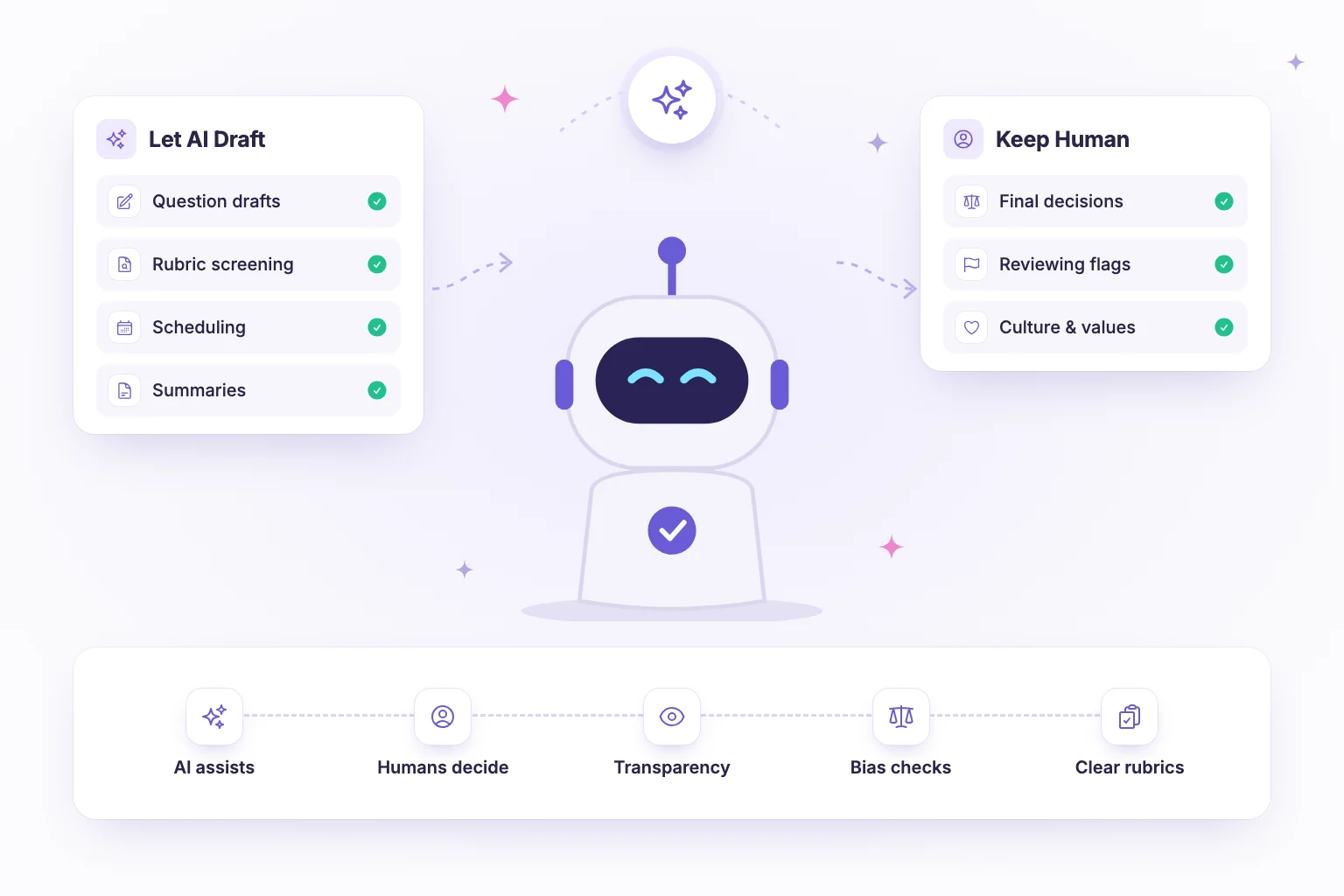
AI in recruitment works best as an assistant, not a decision-maker. It is genuinely useful for drafting assessment questions, screening resumes against a clear rubric, scheduling interviews and summarising candidate information. Final hiring decisions, judgements about team fit and reviews of integrity flags should stay with people who can explain and own the outcome.
The question most teams face is no longer whether to use AI, but where to draw the line. This guide maps the tasks where AI earns its place, the tasks that must stay human, the real risks, and a checklist you can use before rolling out any AI recruiting tool.
Where AI helps in recruitment
The best uses of AI in hiring share a pattern: the task is repetitive, the output can be checked quickly by a person, and a mistake is cheap to catch before it affects a candidate.
Drafting assessment questions
Writing good, role-specific questions takes hours. AI can read a job description, pull out the skills and seniority it implies, and draft a first set of multiple choice, coding, open-ended and video questions. A recruiter or hiring manager then edits, removes and adds questions before anything reaches a candidate. That review step is what keeps the assessment relevant and fair. We cover this workflow in detail in how to go from job description to assessment in minutes.
Screening resumes against a rubric
For roles with hundreds of applicants, reading every resume carefully is not realistic. AI can rank resumes against a screening rubric that lists the skills the role actually needs. The key word is rubric: the AI is only as good as the criteria you give it, and a person should review the shortlist and the borderline cases. See our guide on how to screen resumes faster without missing good candidates.
Scheduling and logistics
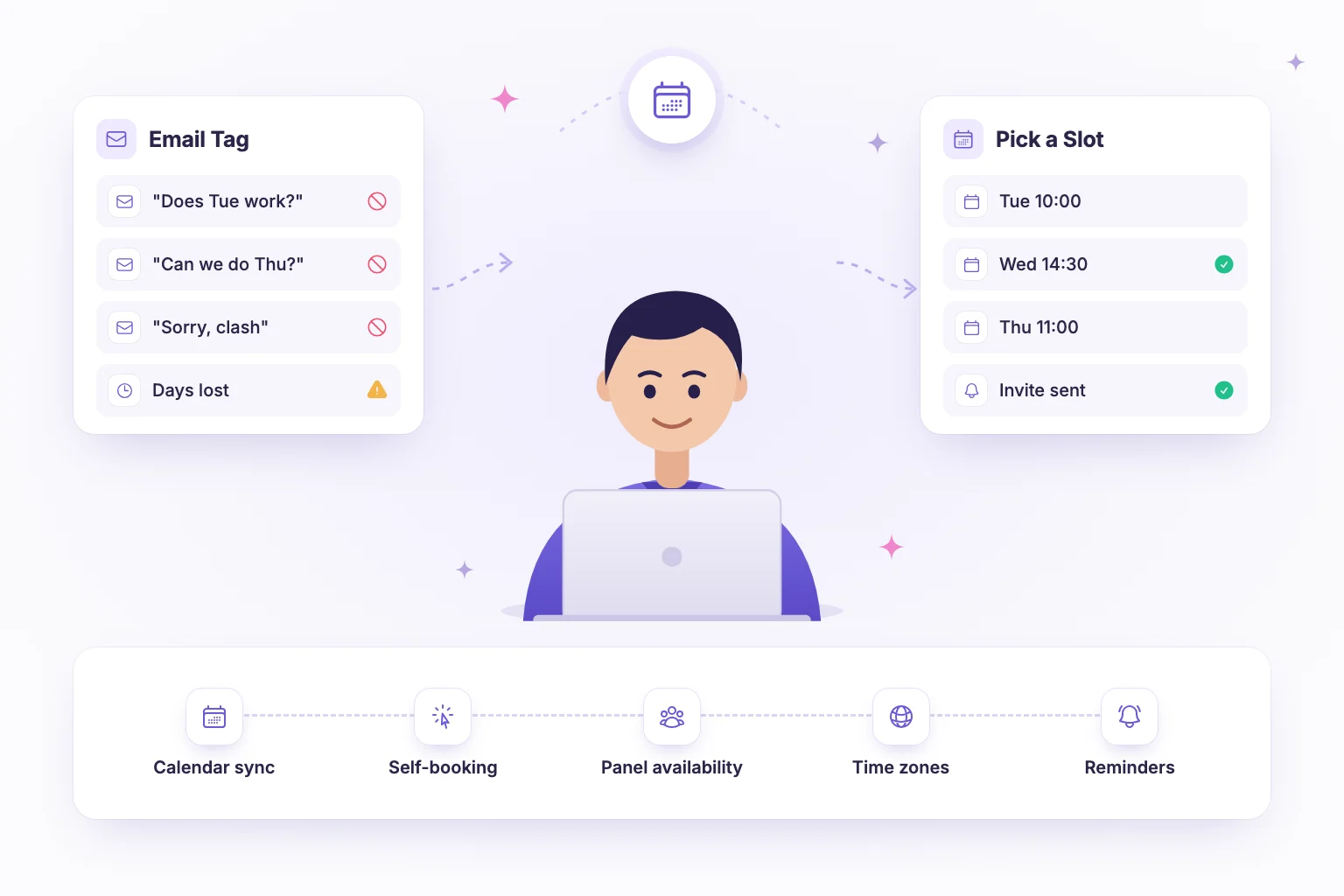
Coordinating calendars is pure overhead. Automation that lets candidates self-book available slots and syncs with interviewers’ calendars removes days of back-and-forth, with almost no risk to fairness.
Summarising and organising
AI can condense long answers, surface the key points of a candidate profile, or highlight where scorecard ratings disagree. Summaries help reviewers focus, but they should point back to the underlying evidence rather than replace it.
What must stay human
Some parts of hiring depend on context, judgement and accountability that AI cannot provide.
- Final hiring decisions. Someone needs to weigh the full picture, explain the reasoning and own the result.
- Defining what good looks like. Deciding which skills matter for a role is a business judgement. AI can suggest; people decide.
- Team and culture judgements. How someone will work with a specific team, handle ambiguity or grow into a role requires conversation and context.
- Reviewing integrity flags. Proctoring can flag a tab switch or a second face, but there are innocent explanations. A person should review the evidence before any flag affects a decision.
- Exceptions and edge cases. Career changers, non-traditional backgrounds and candidates who need accommodations often fall outside what a rubric anticipates.
- Candidate conversations. Offers, rejections with feedback and difficult questions deserve a human voice.
A simple split: AI versus human tasks
| Recruiting task | Good fit for AI | Human role |
|---|---|---|
| Writing assessment questions | Draft questions from the job description | Review, edit and approve before publishing |
| Resume screening | Rank against a skills rubric | Set the rubric, review shortlist and borderline cases |
| Interview scheduling | Offer slots, book and send reminders | Set availability and interview panels |
| Scoring objective questions | Auto-score multiple choice and coding test cases | Check calibration and question quality |
| Proctoring | Detect and flag unusual events | Review evidence and decide what it means |
| Hiring decision | Surface and summarise evidence | Make and own the decision |
The risks of AI in recruitment
Bias at scale
AI does not invent fairness. If a rubric overweights a particular university, job title or phrasing, AI will apply that preference to every applicant, consistently and quickly. Human bias affects one decision at a time; automated bias affects thousands. Screen on job-relevant skills, avoid proxies such as school names, and check outcomes across candidate groups regularly.
Lack of transparency
If nobody can explain why a candidate was ranked low, you cannot defend the decision, correct a mistake or give useful feedback. Prefer tools that show the criteria behind a ranking or score, and keep records of what was reviewed and decided.
Over-automation
The temptation is to let AI auto-reject large parts of the pipeline. That saves time until strong candidates are filtered out for reasons nobody noticed. Automate the logistics freely; automate judgements cautiously and always with review.
Candidate trust and regulation
Candidates increasingly want to know when AI is involved, and rules in several regions now require disclosure, human review or bias audits for automated hiring tools. Check the requirements where you hire, and be open with candidates regardless.
AI on the candidate side
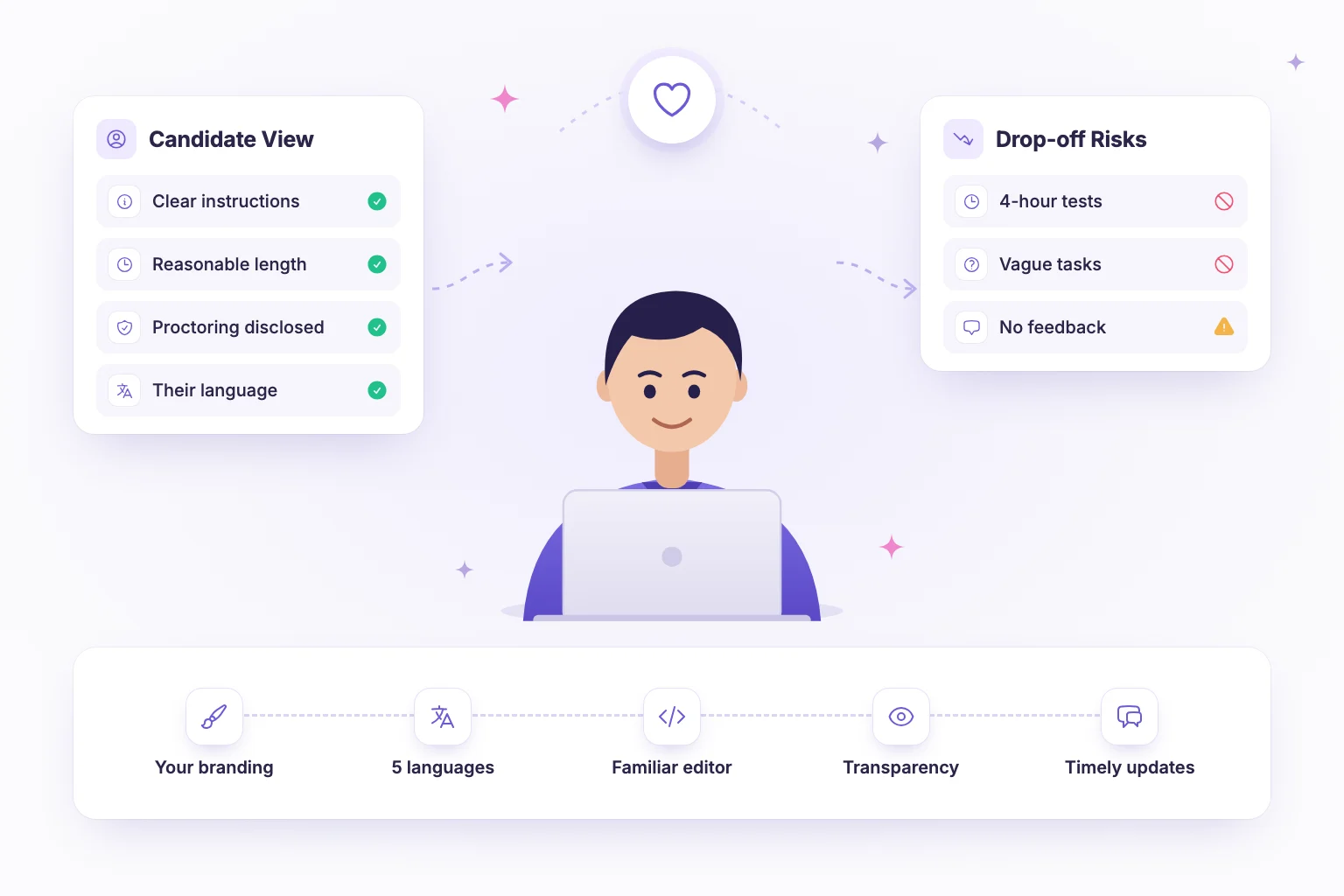
Candidates use AI too. Assessments need to be designed so that they still reveal real ability, which is the focus of our article on designing assessments that stay ahead of AI-assisted cheating.
How to introduce AI recruiting tools step by step
Rolling out AI across the whole hiring process at once makes it hard to tell what is working. A staged approach is safer and gives you evidence as you go.
- Start with low-risk logistics. Scheduling and reminders save time immediately and carry almost no fairness risk.
- Add AI drafting next. Use AI to draft assessment questions for one or two roles, and have hiring managers review every question. Track how much editing is needed; heavy editing means the job description needs work.
- Pilot screening in parallel. For a few roles, let recruiters screen as usual while AI ranks the same resumes against the rubric. Compare the two shortlists and investigate where they differ before relying on the rankings.
- Write down the rules. Document which steps use AI, who reviews the output and who can override it. Share a short version with candidates.
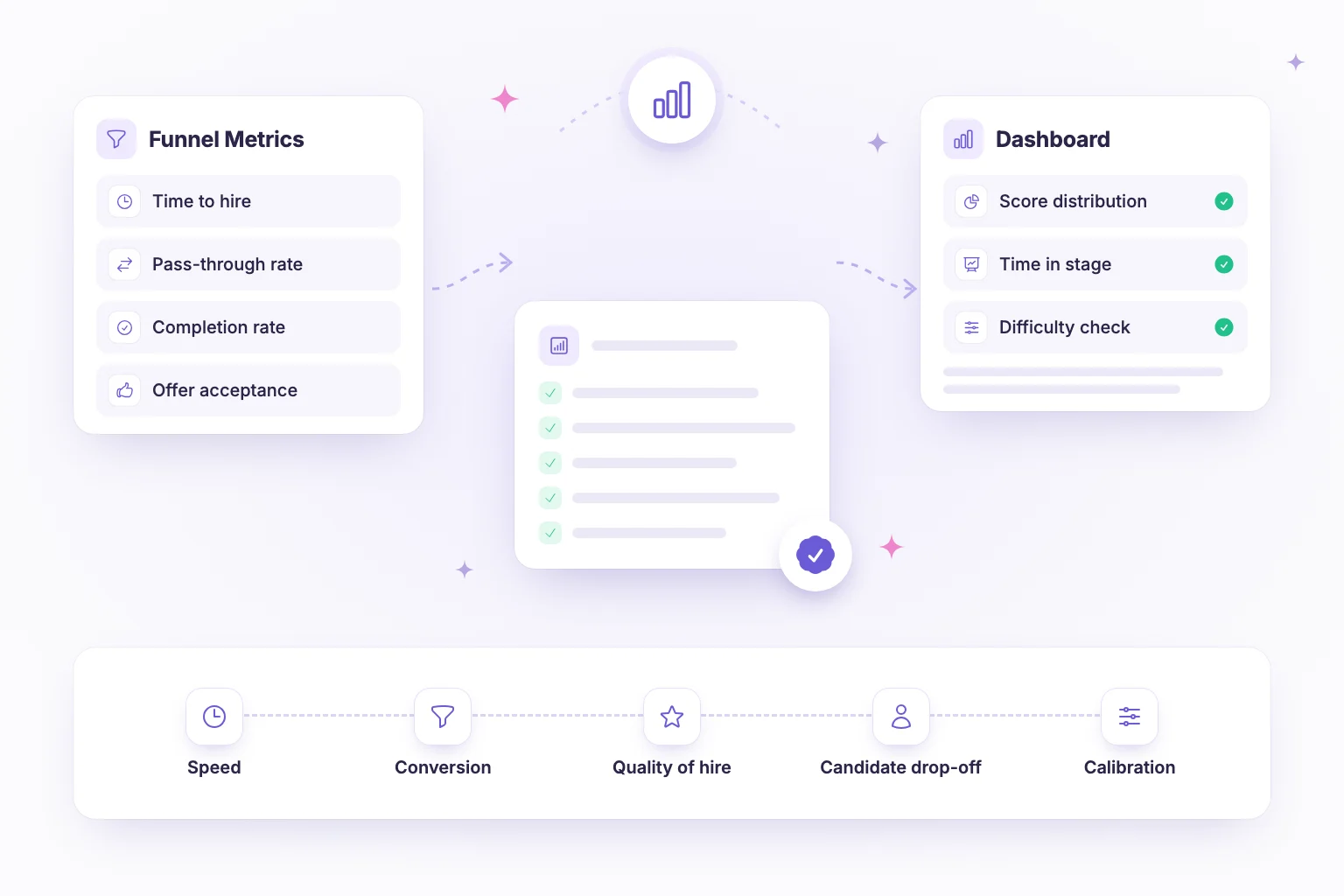
- Measure outcomes, not just speed. Faster screening is only a win if pass-through rates, candidate feedback and quality of hire hold up. Our guide to recruiting metrics that matter covers what to track.
- Review quarterly. Rubrics drift as roles change. Revisit criteria and outcome data regularly and retire anything that is not helping.
Responsible-use checklist for AI in hiring
Run through this list before introducing any AI recruiting tool, and revisit it every quarter.
- Purpose: Is there a specific, time-consuming task this tool solves?
- Criteria: Are the skills and rubrics the AI uses explicit, job-relevant and agreed with hiring managers?
- Review: Does a person review AI output before it affects a candidate?
- Decision ownership: Is it clear who makes and owns each hiring decision?
- Transparency: Do candidates know where AI is used and that people make final decisions?
- Explainability: Can you explain why a candidate was ranked, scored or flagged?
- Monitoring: Are you checking outcomes across candidate groups for unexpected patterns?
- Data handling: Is candidate data access restricted by role and stored securely?
- Compliance: Have you checked local rules on automated decision-making in hiring?
- Exit path: Can a recruiter override the AI, and do they know how?
How NirnAI uses AI in recruitment
NirnAI is designed around the principle that AI prepares and people decide. With AI question generation, you paste or upload a job description and NirnAI extracts the skills and seniority, then generates role-specific multiple choice, coding, open-ended and video questions. Recruiters review and edit every question before publishing, and can clone and reuse assessments across similar roles.
AI resume screening ranks resumes against a screening rubric of the skills the role needs, so the criteria are explicit and your team reviews the shortlist. Structured scorecard templates keep human interview ratings consistent. On integrity, standard proctoring produces an integrity score and flags, and a human reviewer decides what they mean; nothing is treated as proof on its own.
Role-based access means recruiters, hiring managers, reviewers and observers each see only what they need, and an audit trail records key changes. To see how AI can take the preparation work off your team without taking the decisions, start a 14-day free trial of NirnAI.
Frequently asked questions
- How is AI used in recruitment?
- AI is most commonly used to draft job-specific assessment questions, rank resumes against a set of required skills, automate interview scheduling, and summarise candidate information for reviewers. The strongest use cases save recruiters time on repetitive preparation and sorting work, while people keep responsibility for evaluating candidates and making hiring decisions.
- Can AI make hiring decisions on its own?
- It should not. AI can rank, flag and summarise, but final hiring decisions should stay with people who can weigh context, explain their reasoning and be accountable for the outcome. Fully automated rejection or selection increases the risk of unfair outcomes and makes it hard to explain decisions to candidates or regulators.
- Does AI in recruitment introduce bias?
- It can. AI systems may reflect patterns in the data or criteria they are given, so a poorly chosen rubric or a biased job description can be amplified at scale. Reduce the risk by screening against explicit, job-relevant skills, reviewing AI output before acting on it, monitoring outcomes across candidate groups and keeping a human decision-maker.
- Should you tell candidates you use AI in hiring?
- Yes. Tell candidates which parts of the process use AI, what it does, and that people make the final decisions. Transparency builds trust, helps candidates prepare properly, and in some jurisdictions is a legal requirement. A short, plain-language note in the job posting or assessment invitation is usually enough.