Friday, June 26, 2026
Campus Recruitment Process: A Step-by-Step Plan for 2026

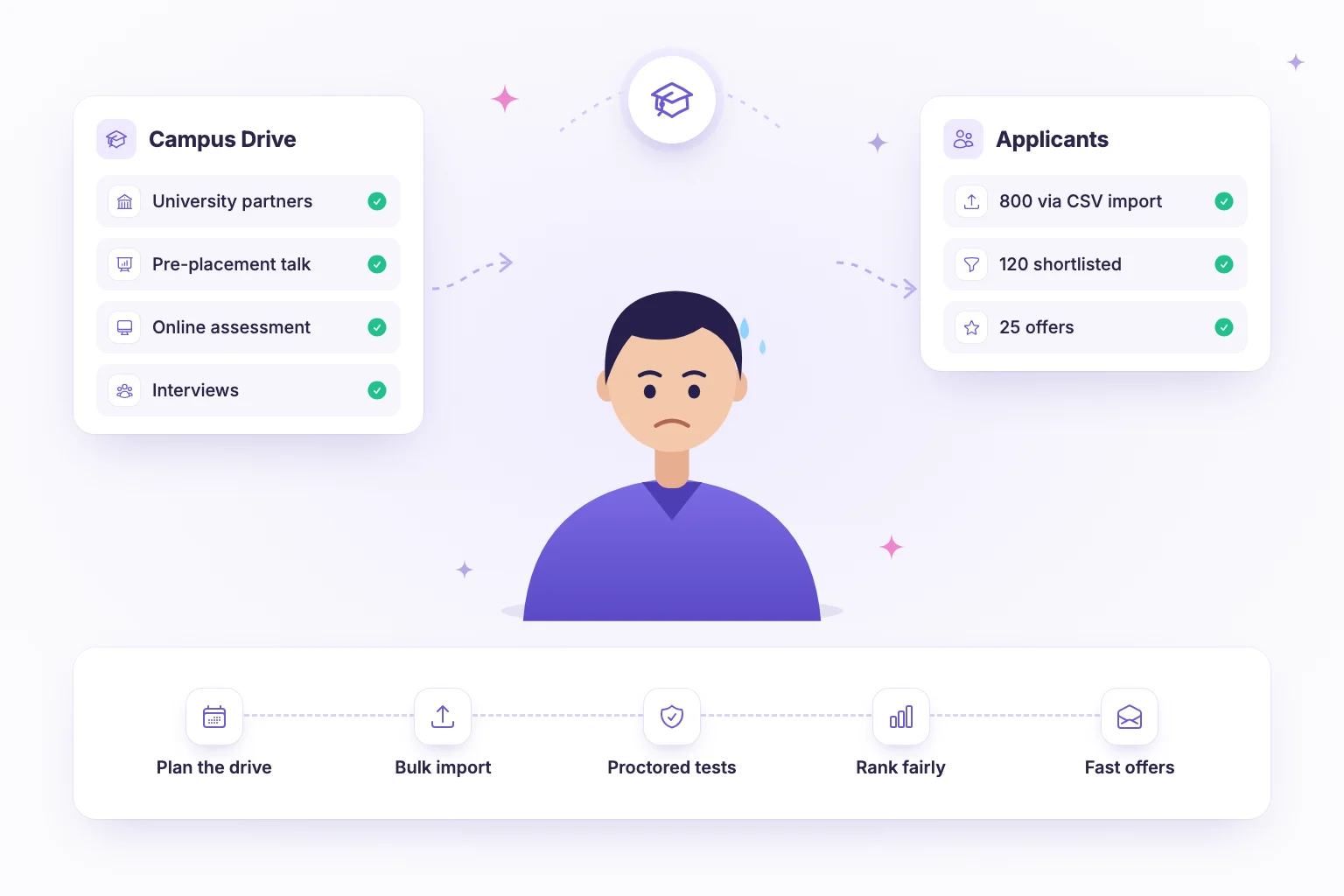
A campus recruitment process is the sequence of steps a company uses to hire graduating students directly from universities: building partnerships, running pre-placement talks, screening with an online assessment, shortlisting, interviewing and making offers. The best campus programmes are planned backwards from the university calendar, test fundamentals and potential rather than experience, and are built to handle hundreds of candidates in a few days without losing fairness.
This guide walks through each stage of a campus hiring drive, with a timeline you can adapt, sample assessment content for fresher roles and the operational details that tend to go wrong when volume spikes.
Why the campus recruitment process needs its own playbook
Campus hiring looks like ordinary hiring with more candidates, but the differences run deeper. Students have little or no work history, so resumes carry less signal. Universities control the calendar, so your dates are often fixed months ahead. And everything happens in bursts: hundreds of applications arrive in a single evening, and interview panels need to see dozens of students in one or two days.
That combination means the usual approach of reading every resume and scheduling interviews one by one breaks down quickly. A dedicated playbook sets the criteria, tools and schedule before the drive opens, so the team can focus on evaluating students rather than chasing logistics.
Stage 1: Build university partnerships
Start three to four months before you want offers signed. Pick a manageable set of universities based on the programmes that match your roles, not just reputation. Many teams find that a mix of well-known institutions and strong regional colleges produces a broader, more diverse pool.
- Contact the placement or careers office early and ask for their calendar, eligibility rules and preferred format (on-campus, virtual or hybrid).
- Agree on logistics: rooms or lab access for the assessment, internet reliability, the number of interview slots per day and who on campus is your point of contact.
- Share a clear job brief for each role: responsibilities, location, compensation band, and what the selection process involves.
Stage 2: Run pre-placement talks that set expectations
A pre-placement talk is your chance to explain the company, the roles and the selection process. The most useful talks are specific: what a new graduate actually works on in the first six months, what the training looks like and exactly which rounds students will face.
Be explicit about the assessment. Tell students how long it is, which question types to expect, which programming languages are allowed and whether it is proctored. Point them to preparation material such as a candidate guide to taking online assessments. Students who know what to expect perform closer to their real ability, which makes your results more reliable.
Stage 3: The online assessment round
The online assessment is where a campus hiring drive either scales or stalls. It replaces resume screening as the primary filter, so it has to be well designed, identical for every candidate and quick to score.
Assess fresh graduates on potential and fundamentals
Graduates have not had the chance to prove themselves on the job, so test what predicts growth: core concepts, reasoning and how they approach unfamiliar problems. A typical structure for a software engineering fresher role:
- Multiple choice (20 to 25 minutes): programming fundamentals, data structures, basic complexity, databases and networking concepts.
- Coding (30 to 40 minutes): one easy and one medium problem with test cases, solvable in the language the student knows best.
- Open-ended or video (10 minutes): one short prompt such as "Describe a project where something did not work the first time. What did you change?"
Keep the total under 90 minutes. Longer tests reward endurance more than skill and increase drop-off. For non-technical roles, swap the coding section for a case-style written question relevant to the job. Our guide to assessment question types that predict job performance covers how to mix formats.
Sample fresher questions
- MCQ: "What is the time complexity of searching for a value in a balanced binary search tree?"
- Coding: "Given a list of student scores, return the top three distinct scores in descending order."
- Open-ended: "You are given a bug report you cannot reproduce. What are your first three steps?"
Run it at scale
Import the full candidate list from the university in one go rather than inviting students manually, send invitations with a clear window (for example, a fixed two-hour slot for on-campus sittings or a 48-hour window for remote ones) and have a support contact ready for technical issues. If the round is remote, use proctoring as a deterrent and tell students exactly what is monitored.
Stage 4: Shortlisting hundreds of candidates at once
Decide the shortlisting rule before results come in. A common approach is to combine a minimum score on the auto-scored sections with human review of the open-ended answers for candidates near the cut-off. This prevents the cut-off from quietly shifting once reviewers see the numbers.
- Score objective sections automatically so the first ranking is ready within minutes of the window closing.
- Review borderline candidates by hand against a shared rubric instead of drawing a hard line one point below the median.
- Check integrity flags with a person, not a rule. A flag is a prompt to look at the evidence, not a verdict.
- Avoid proxy filters such as grade cut-offs or college tier alone; they remove capable students without measuring anything the job needs.
Stage 5: Interviews that are consistent across panels
On interview day you may have four or five panels running in parallel. Consistency matters more than brilliance here: every student should face comparable questions and be rated on the same scale. Give every interviewer a structured interview scorecard with three to five criteria, such as problem solving, communication, fundamentals and learning ability, each with anchored rating descriptions.
Use the assessment results to guide the conversation. Asking a student to walk through the coding solution they submitted is a quick way to confirm understanding and see how they explain their thinking. Keep technical interviews to 30 to 45 minutes and leave ten minutes between slots so panels can complete scorecards while memory is fresh.
Stage 6: Offers and pre-joining engagement
Hold a calibration meeting the same evening or the next morning. Compare scorecards across panels, resolve disagreements with evidence and make decisions while the university is still expecting results. Speed matters: students often receive several offers during placement season, and the company that communicates first and clearly has an advantage.
After offers are accepted, stay in touch. A short onboarding email sequence, an invitation to meet the team or a pre-joining learning plan reduces the number of students who accept and later drop out.
Campus hiring drive timeline
Use this as a starting template and align the dates with each university's placement calendar.
| Week | Stage | Key activities | Owner |
|---|---|---|---|
| 1–3 | University partnerships | Shortlist universities, contact placement offices, confirm dates and eligibility | Talent acquisition lead |
| 4–5 | Role and assessment design | Finalise job briefs, build and review the online assessment, agree shortlisting rules | Recruiter and hiring manager |
| 6 | Pre-placement talks | Present roles, explain every round, share preparation material | Recruiter and engineers |
| 7 | Online assessment | Import candidates, send invitations, run the test window, provide support | Recruiter |
| 8 | Shortlisting | Auto-score, review borderline and open-ended answers, check integrity flags | Recruiter and reviewers |
| 9–10 | Interviews | Parallel panels, structured scorecards, same-day calibration | Interview panels |
| 10–11 | Offers | Issue offers, answer questions, collect acceptances | Talent acquisition lead |
| 12+ | Pre-joining | Onboarding communication, learning plan, team introductions | Hiring manager |
Common campus recruitment mistakes
- Designing the test the week before. Rushed assessments tend to be too hard, too long or full of ambiguous questions.
- Reusing the same test every year. Questions circulate between batches; refresh or rotate them each season.
- Silence after the assessment. Tell every student when results will be shared, including those who did not progress.
- Uncalibrated panels. Without a shared scorecard, the panel a student happens to meet decides the outcome more than their ability.
How NirnAI helps with the campus recruitment process
NirnAI is built for the burst of volume that a campus drive creates. You can bulk import candidates from a CSV supplied by the placement office and invite everyone at once. AI question generation takes the job description for a graduate role, extracts the skills and seniority, and drafts multiple choice, coding, open-ended and video questions pitched at fresher level. Your team reviews and edits every question before publishing, and can clone the assessment for the next university.
Multiple choice questions and coding test cases are scored automatically, and the in-browser coding editor supports nine languages, so students can answer in the one they learned. Standard proctoring on every plan tracks face presence, tab switches, fullscreen exits and copy/paste events, and produces an integrity score and flags that a human reviewer decides on. Structured scorecards keep interview panels consistent, while visual workflows move shortlisted students to interview booking automatically.
See how it fits your programme on the campus hiring solution page, or start a 14-day free trial and build your first fresher assessment today.
Frequently asked questions
- How long does a campus recruitment process usually take?
- A well-run campus recruitment process typically spans eight to twelve weeks from first contact with the university to signed offers. Partnership setup and pre-placement talks take the first few weeks, the online assessment and shortlisting take one to two weeks, and interviews and offers usually fit into the final two or three weeks. Planning backwards from the university placement calendar keeps every stage on time.
- What should an online assessment for fresh graduates test?
- Test fundamentals and potential rather than experience. For technical roles that means core programming concepts, data structures, logical reasoning and one or two short coding problems in a language the student already knows. Add a brief written or video question on how they approach a problem. Keep the whole test under 75 to 90 minutes so it measures ability instead of stamina.
- How do you shortlist hundreds of campus applicants fairly?
- Set the shortlisting criteria before the assessment opens, apply the same test to every candidate, and let objective sections such as multiple choice and coding test cases be scored automatically. Then have reviewers look at borderline scores and open-ended answers against a shared rubric. Avoid filtering on college tier or grade cut-offs alone, because they exclude capable students without measuring skill.
- Should campus assessments be proctored?
- For a large, remote online round, proctoring is a sensible deterrent and gives reviewers evidence if something looks unusual. Tell students in advance what is monitored, such as camera, tab switches and fullscreen exits, and make sure flags are reviewed by a person before any decision. Transparency keeps the process fair and reduces anxiety for first-time test takers.