Thursday, April 16, 2026
Take-Home vs Live Coding Interview: Which Gives Better Signal?

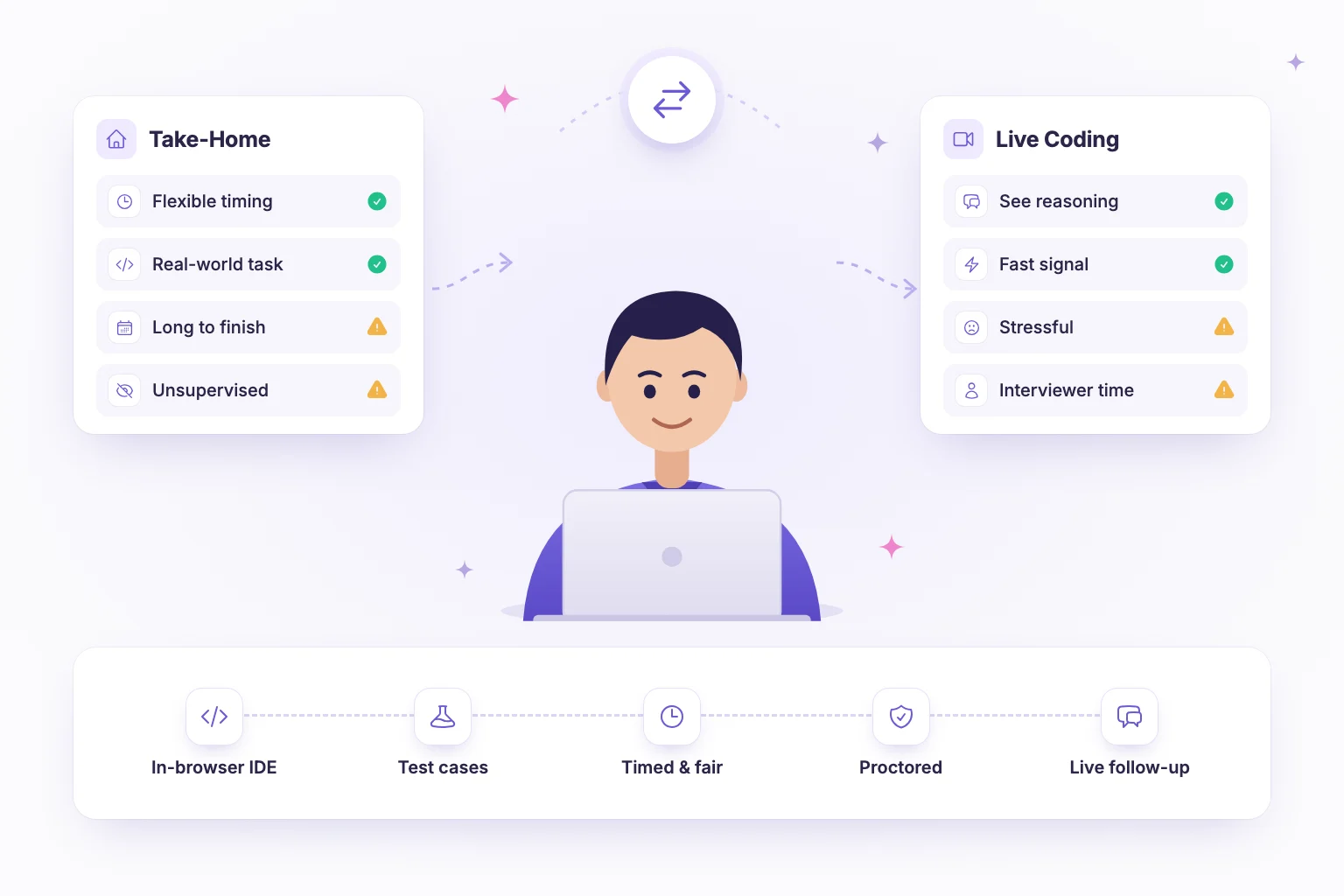
The take-home vs live coding interview debate comes down to what you want to see. Take-home assignments show how a candidate writes code with time to think; live coding shows how they reason and communicate under observation. For most engineering roles, a hybrid works best: a short, timed practical exercise followed by a live discussion where the candidate explains and extends their solution.
Below we compare the two formats across signal, candidate experience, time cost, fairness and integrity, then explain when to use each and how to design a hybrid.
Take-home vs live coding interview: side-by-side comparison
| Factor | Take-home assignment | Live coding interview |
|---|---|---|
| Signal | Code quality, structure, testing habits, realistic problem-solving | Reasoning process, communication, how they handle hints and ambiguity |
| Candidate experience | Less pressure, but long or open-ended tasks feel like unpaid work | Time-efficient, but performance anxiety affects some candidates strongly |
| Candidate time | Often 2–6 hours if unbounded; 1–2 hours if timed | 45–90 minutes, scheduled |
| Interviewer time | Review time per submission; no scheduling needed | One or two engineers for the full session, plus scheduling |
| Fairness | Favours candidates with free time if untimed; flexible for time zones and caregivers | Same conditions for all, but penalises nervous or non-native speakers if poorly run |
| Integrity | Harder to verify who wrote the code or what help was used | Easier to observe directly, though still possible to get outside help remotely |
| Scalability | Scales well to many candidates | Limited by interviewer availability |
The case for take-home coding assignments
Take-homes are closest to how engineers actually work: alone, with an editor they know, time to read the problem and room to test. They are good at showing:
- Code organisation: naming, structure, separation of concerns.
- Testing habits: whether the candidate checks edge cases and writes tests.
- Reading a spec: whether they deliver what was asked, without over-engineering.
They also scale. You can send an assignment to fifty candidates without booking fifty interview slots, and candidates in any time zone can complete it when it suits them.
Where take-homes go wrong
- No time limit. "Should take about three hours" often becomes a weekend. Strong candidates with several offers may decline.
- Unclear scoring. Reviewers apply different standards, so results are hard to compare.
- Authorship questions. You cannot easily tell how much help the candidate had, including from AI tools. Our piece on designing assessments that stay ahead of AI cheating covers this in depth.
The case for live coding interviews
A live coding interview, or pair programming interview, lets you watch the candidate think. You see how they clarify a problem, whether they talk through options, and how they respond to a hint or a changed requirement. That is valuable for roles where collaboration and communication matter as much as raw output.
Live sessions are also efficient for candidates. One scheduled hour replaces an open-ended take-home, and they get a sense of what working with your engineers is like.
Where live coding goes wrong
- Performance anxiety. Some capable engineers struggle to code while being watched, especially early in the session.
- Puzzle questions. Algorithm trivia under time pressure rewards practice with that format more than job skill.
- Unfamiliar tools. Forcing a specific language or a bare text box without autocomplete measures tool fluency, not ability.
- Interviewer variance. Different interviewers give different hints and apply different standards unless a rubric is used.
When to use which technical interview format
Choose based on the role and your hiring constraints:
- High applicant volume or campus hiring: a timed, auto-scored practical is the only format that scales. Follow up live with a shortlist.
- Senior and staff roles: a short practical plus a live design discussion. Senior candidates care about respect for their time.
- Roles heavy on collaboration (for example, pairing-heavy teams or client-facing engineers): weight the live session more.
- Remote, distributed hiring: asynchronous practicals avoid time-zone scheduling problems, with a live session booked afterwards.
- Junior roles: a short practical with clear instructions, then a supportive live walkthrough focused on learning ability.
The hybrid approach: timed practical plus live discussion
The hybrid keeps the strengths of both formats and limits their weaknesses. It has two parts.
Part 1: A timed, proctored practical (60–90 minutes)
- One or two realistic coding tasks with visible and hidden test cases, so correctness is scored consistently.
- An in-browser editor with syntax highlighting and autocomplete, and a choice of language.
- A short open-ended question on design or trade-offs.
- A fixed time window, so every candidate works under the same conditions.
- Clearly communicated rules on allowed resources, and transparent proctoring that records signals such as tab switches and copy-paste events for a human to review.
Part 2: A live discussion (45–60 minutes)
- The candidate walks through their solution and explains the choices they made.
- The interviewer asks them to extend it: add a feature, handle a new edge case or improve performance.
- Discussion of testing, failure modes and what they would do with more time.
The live discussion is the most effective integrity check you have. Candidates who wrote their own code can explain and modify it comfortably. It also gives nervous candidates a chance to shine after they have already shown what they can do. Score both parts with a structured rubric; our guide to building an interview scorecard includes a backend engineer template you can adapt.
How to score the hybrid consistently
Two formats produce two kinds of evidence, so score them separately before combining:
- Correctness (practical): the share of test cases passed, including hidden edge cases. This part is objective and can be automated.
- Code quality (practical): readability, structure and naming, rated by a reviewer on a 1–4 rubric.
- Reasoning (live): how clearly the candidate explains their choices and the trade-offs they considered.
- Adaptability (live): how well they extend or change the solution when requirements shift.
- Communication (live): whether they think aloud, ask clarifying questions and respond well to hints.
Agree in advance how much each part matters for the role. For a pairing-heavy team, the live criteria might carry more weight; for an independent backend role, correctness and code quality might. Whatever you choose, write it down before the first candidate starts, so the weighting is not adjusted to fit a candidate the panel already likes. If a candidate scores well on the practical but cannot explain their code live, treat that as a serious gap to discuss openly in the debrief, not as an automatic conclusion that they cheated.
Designing a fair coding assessment
- Base tasks on real work your team does, not on well-known puzzles.
- State the time limit, the language options and the allowed resources up front.
- Use test cases to score correctness, and a rubric to score readability and approach.
- Pilot the task with a current team member to check the time estimate.
- Give every candidate the same brief, conditions and scoring.
- Share prep information. A candidate preparation page reduces anxiety and questions.
How NirnAI supports take-home and live coding interviews
NirnAI is built for the hybrid approach. Candidates complete practicals in an in-browser coding editor with syntax highlighting, autocomplete and test cases, in any of nine languages: Python, JavaScript, TypeScript, Java, C, C++, Go, Ruby and Rust. You can combine coding tasks with multiple-choice, open-ended and video questions in the same coding assessment.
Standard proctoring is included on every plan. It tracks face presence and head pose, tab switches, window focus loss, fullscreen exits and copy-paste events, records the screen, and produces an integrity score and flags for a human reviewer to decide on. It is a deterrent and an evidence tool, so we recommend telling candidates exactly what is monitored. On the Pro plan, advanced proctoring can pair the candidate's phone as a second camera showing a side view of the desk.
For the live stage, interview scheduling with Google Calendar and Microsoft Outlook lets shortlisted candidates self-book a slot, and structured scorecards keep every interviewer on the same rubric.
Try it on your next engineering role: start a 14-day free trial.
Frequently asked questions
- Are take-home coding assignments better than live coding interviews?
- Neither is better in every case. Take-home assignments show how candidates write code with time to think, while live coding shows how they reason and communicate in real time. Take-homes can be long and harder to verify; live sessions can penalise candidates who get nervous. Many teams get the best signal from a short timed practical followed by a live discussion of the solution.
- How long should a take-home coding assignment be?
- Keep it to what a competent candidate can finish in about 60 to 120 minutes, and say so clearly in the brief. Open-ended assignments with no time limit tend to reward candidates with the most free time rather than the most skill, and they increase drop-off. A timed exercise with a defined scope is fairer and easier to compare across candidates.
- How do you stop candidates cheating on take-home coding tests?
- No method guarantees integrity, but you can make shortcuts less useful and easier to spot. Use realistic tasks rather than well-known puzzles, set a time limit, and follow up with a live discussion where the candidate explains and extends their code. Proctoring signals such as tab switches and copy-paste events can add evidence for a human reviewer. Always tell candidates the rules up front.
- What should a live coding interview assess?
- A live coding interview should focus on how the candidate approaches a problem: clarifying requirements, breaking it down, choosing a data structure, testing edge cases and explaining trade-offs. It is less suited to judging polished, production-quality code. Let candidates use a language they know, allow them to look up syntax, and score them on a structured rubric rather than on whether they finished.